
Seven Habits to Protect Your Money: It Can Never Truly Be Taken from You!
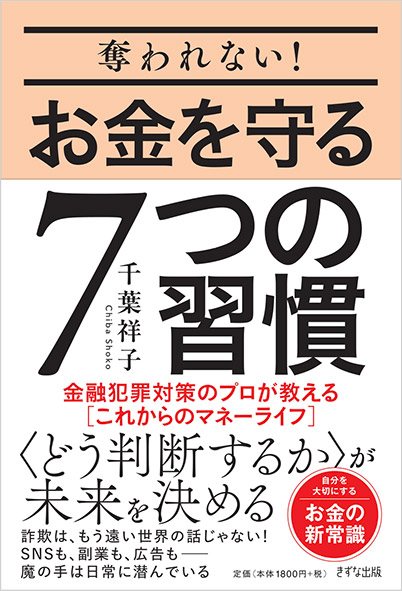
Writing my first book
I left Goldman Sachs at the end of 2019. Shortly after, the world was shaken by the pandemic.
While people all around the world suddenly found themselves stuck at home, I began streaming online live, which was still rare at the time. Later, the social media platform Clubhouse allowed me to connect deeply with many people in a live setting, and I realized that it was possible to make meaningful connections with people even in situations where it was not realistic to meet in person.
I first met bestselling author Ken Honda in 2017, and as I continued learning from him as a mentor, the desire to write a book of my own someday grew stronger over time.
Until then, I was so used to spending all my time working and maybe playing golf as a part of socializing and networking that when I finally sat down and put my pen to paper, nothing came out. I felt stuck and didn’t know where to begin.
Suddenly, I was devastated by the thought that I might not have enough content to fill an essay, much less a book.
While the friends that surrounded me published their books one after another, I turned my energy to supporting them instead, organizing lunch parties, serving as the event host, and helping get the word out so many people could join. All the while, I was inwardly criticizing myself and comparing myself negatively.
My breaking point came when I attended a program designed to train authors, hosted by Contents Creative. The advice that completely flipped my thinking around came from Tokiko Okamura, president of the Kizuna Publishing house, and bestselling Japanese author Shigehisa Nagamatsu.
The words of advice that etched into my heart were, “There is a treasure chest of experiences within you that could benefit and help many people.”
In other words, the content I was looking for was inside me all along.
The gears that had stopped in their tracks began to turn once again.
In all my time working in the world of finance, and specifically in the field of financial crime compliance, a place I never wanted to revisit, that’s where I discovered the message that I most wanted to share at that time, and I was the only one who could write about it from my own perspective.
After that realization hit me, the words began to flow out effortlessly.
I knew I wanted to deliver this content to as many people as possible and save even one more person from the pain of suffering because of money.
What it really means to protect your money
I knew that I wanted to teach people how to protect their money. But what does that even mean?
When I talk about protecting your money, I don’t mean hoarding it behind lock and key where no one can find it. I’m talking about really treating yourself lovingly and preventing your money from flowing out in unnecessary directions. I’m also talking about healing the emotions in your heart.
Money that is carefully protected becomes a close friend and supportive ally by your side, always there when you need it most. It can then be used with a sense of security and strong intention, knowing exactly where it needs to go.
Money that is used intentionally and meaningfully transforms into value, circulates in a positive flow, and finds its way back to you carrying more abundance as it returns full circle.
This cycle of protecting and receiving is my definition of true wealth.
Steve Jobs once said in his famous Stanford commencement speech, “Connect the dots.”
I looked back on my life at all the seemingly unrelated dots and watched as they connected into the line of a beautiful story that only I could tell, and it began to push my life forward in a powerful way.
Ultimately it culminated into my first book, “Seven Habits to Protect Your Money: It Can Never Truly Be Taken from You!”
I was surprised at what a gentle but powerful message I was able to share in that book. I taught people how to reduce wasteful spending and stop the unnecessary outflow of your own abundance. I taught how to align your spending habits with your ikigai and what brings you the most meaning in your life. As a result, the money you spend actually transforms into even more value and returns to you as increased abundance. It’s like magic.
Through writing this first book and speaking with many people about it, I realized an important truth: The most important thing in life is not money itself, but rather connecting with wonderful friends, great mentors, and beautiful people by your side.
You don’t need to have perfect financial literacy. As long as you have supportive friends around you, that’s enough to make you feel safe and secure. No amount of money can do that for you. It comes from inside.
So, create a circle of friends who you can enjoy your life with no matter what is happening on the outside.
Bibliography

In her debut book, Shoko Chiba draws on nearly three decades of experience in global finance, including her role as Head of Financial Crime Compliance, to offer a practical and extremely down to earth approach to protect your money and happiness in today’s increasingly complex world.
Rather than a focus on advanced financial knowledge or investment strategies, Shoko sets this book apart by emphasizing everyday awareness and how to make smart, supportive decisions. She introduces seven essential habits designed to help you avoid unnecessary financial loss, navigate modern risks such as scams and misinformation, and develop a grounded, intuitive relationship with money itself.
At its core, this book reframes the notion of “protecting your money” as an act of self-respect and care. By cultivating clarity, emotional balance, and the ability to pause, verify, and even say no when necessary, readers learn how to create their own sense of safety and stability in both their financial and personal lives. Shoko’s approach integrates practical financial wisdom with deeper psychological awareness, offering a new model of wealth based on both protection and greater mindfulness in practice.
These seven habits brought to you by Shoko Chiba teach you how to make calm, conscious financial decisions so that your money and self-worth cannot be taken from you.
Habit 1: Trust your intuition
Develop the ability to sense when something feels “off” and pause before taking action.
Habit 2: Have the Courage to Say No
Protect your time, energy, and money by declining requests or opportunities that don’t feel right.
Habit 3: Pause Before You Act
Avoid impulsive decisions, especially in emotional or high-pressure situations.
Habit 4: Verify for Yourself
Don’t rely on assumptions or appearances. Check facts, sources, and details before making decisions.
Habit 5: Understand and Track Your Money
Know where your money is going and stay aware of your inward and outward financial flow.
Habit 6: Keep Promises to Yourself
Build self-trust by following through on the decisions you make and keeping your boundaries.
Habit 7: Treat Yourself with Care and Respect
Approach money as an extension of how you treat yourself. Cultivate self-love, not fear.