“7 Habits to Protect Your Money”—Why It Turned Out to Be a Book About Life
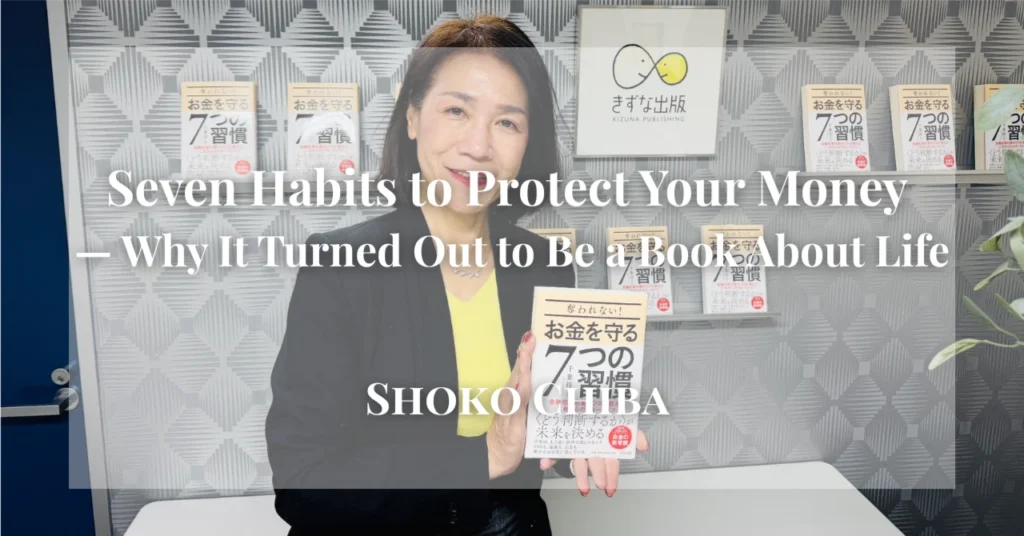
(Summary in English)
My book, 7 Habits to Protect Your Money, was recently featured in Nikkei WOMAN, one of Japan’s leading magazines for professional women.
The special issue focused on a growing concern in Japan: the rapid increase in financial fraud. What makes this trend particularly alarming is that victims are no longer limited to older generations. Investment scams, romance scams, phishing attacks, and identity fraud are increasingly affecting people in their 20s, 30s, 40s, and beyond.
In the article, financial crime experts explained how advances in AI and digital technology have made scams far more sophisticated and difficult to detect. Fake investment websites, deepfake videos, and highly convincing online schemes are becoming part of everyday life.
For many years, personal finance education focused primarily on how to earn more, save more, and invest more. However, the message of this feature was different:
Before growing your wealth, you must learn how to protect it.
That idea is at the heart of my book.
Yet as I reflected on the interviews, I realized that this message goes far beyond money.
Protecting your money also means protecting your judgment, your peace of mind, your relationships, and your future. Many scams succeed not because people lack intelligence, but because they are rushed, isolated, emotionally vulnerable, or afraid to ask for help.
One of the most important habits I shared in the article is to have trusted people you can talk to about financial decisions. Another is to pause and ask yourself:
“Is this truly something I need?”
That simple question often leads to better decisions—not only in finance, but in life.
Perhaps that is why 77 Habits to Protect Your Money ultimately became more than a book about money. It became a book about living wisely, making conscious choices, and protecting what truly matters.
Shoko Chiba’s Feature Article in “President” Magazine #1

(Summary in English)
This article, featuring the concepts in Shoko Chiba’s book, explores why people continue to fall victim to financial scams and identifies common psychological patterns behind it. She offers practical advice so readers can make smarter decisions without being taken advantage of.
Shoko explains that many people are drawn to offers that appear on the surface to be advantageous. We’re especially attracted to those who frame offers as free, limited in time or quantity, or available “only now! Act fast!” These phrases trigger emotional reactions such as urgency or the fear of missing out, which weaken our ability to make rational judgments.
One key insight she highlights is that people often believe they are too smart to be deceived, which ironically makes them more vulnerable.
The article also introduces the concept of reciprocity: When people receive something (even something free), they feel an unconscious need to give something back. This psychological tendency is frequently exploited in both normalized product marketing and scams.
Importantly, Shoko emphasizes that even when something is not technically a scam, people can still “lose” money, time, or personal information and privacy by making decisions in an unconscious manner.
The core message of this article is that financial loss doesn’t happen only because of bad actors. It often happens because of our own unconscious habits and emotional reactions that override our ability to think more clearly. By becoming aware of these psychological patterns and learning to pause, question, and verify, individuals can make clearer, more empowered financial decisions.
Shoko Chiba’s Feature Article in “President” Magazine #2

(Summary in English)
In this second article featured in President Magazine, Shoko Chiba explains to readers how to identify fraudulent or untrustworthy financial advertisements, especially in the growing landscape of online and social media scams.
She points out that while many scams appear convincing, financial advertisements are actually governed by specific rules and structures. By understanding those rules, individuals can better judge whether an offer is legitimate or suspicious.
One of the key insights she shares is that people often focus only on visible benefits, such as high returns, without paying attention to the hidden costs. Even hen returns appear attractive, fees, commissions, and other expenses can significantly reduce actual gains.
Shoko expands this idea further by introducing the concept of both visible costs (fees, charges, and commissions) and invisible costs (time, stress, and emotional burden). These hidden factors affect not only financial outcomes but also your overall well-being.
The core message is that people don’t lose money only because of scams. We often lose money because we fail to see the full picture, including hidden costs and psychological impact.
Shoko’s practical advice is to check all fees and deductions carefully, to look at the total outcome over time and not just short-term gains. Also, to understand and ask yourself whether the cost, both visible and invisible, is truly worth it.